
What to Eat on GLP-1 Weight Loss Medications: The Dietitian's Guide to Protecting Your Muscle
Jun 08, 2026
You've started Ozempic, Wegovy or Mounjaro. You're eating less — probably a lot less. The medication is doing exactly what it's supposed to do. But here's the question most people aren't being asked by their health care team: what are you actually eating?
As an Accredited Practising Dietitian, I can tell you that what you eat on GLP-1 weight loss medications matters enormously — possibly more than at any other point in your life. Not because you need to diet on top of your medication, but because when your appetite is suppressed and you're eating far less, every single bite needs to work harder for your health.
This guide gives you the clinical evidence behind GLP-1 nutrition, practical protein targets, and a simple framework for protecting your muscle and your long-term wellbeing.
Why Nutrition Matters MORE on GLP-1 Medications
Your appetite is suppressed — but your nutrient needs aren't
GLP-1 receptor agonists work by slowing gastric emptying and suppressing appetite signals in the brain. For many people, this means eating 30–50% less food than they previously consumed. That is an extraordinary physiological change — and it creates a real nutritional challenge.
A landmark 2026 systematic review from the University of Newcastle examined 41 randomised controlled trials of GLP-1 and GIP medications involving over 50,000 participants. Researchers found that only two of those 41 trials assessed or reported what participants were actually eating.
"A reduction in body weight does not automatically mean the person is well nourished or healthy," said Professor Clare Collins, Laureate Professor of Nutrition and Dietetics at the University of Newcastle. "When people are eating less, the quality of what they eat matters even more."
The real risk: nutrient deficiencies hiding behind weight loss numbers
The same review noted case reports of thiamine (vitamin B1) deficiency and protein malnutrition in GLP-1 patients — serious conditions that can go undetected while the scales are moving in a favourable direction. If someone loses weight but their diet lacks adequate protein, fibre, vitamins or minerals, that has major implications for long-term muscle mass, bone health, gut health and overall wellbeing.
The Muscle Loss Problem — And Why It's Not Inevitable
What the research actually shows
Your body has evolved over millions of years to maintain its weight. When you lose weight rapidly — regardless of how — some of that weight will come from lean muscle mass, not just body fat.
The good news: this is highly modifiable. A study presented at the ENDO 2025 conference found that higher protein intake significantly reduces the risk of muscle loss in patients taking semaglutide — particularly in women and older adults. A 2026 paper in the American Journal of Medicine confirmed that musculoskeletal outcomes on GLP-1s are strongly influenced by modifiable factors: dietary protein intake and resistance exercise.
Who is most at risk of muscle loss?
Older adults (particularly women post-menopause), people who are not engaging in resistance training, and those who significantly reduce their total food intake without prioritising protein are at highest risk. This is not cause for alarm — it is cause for a proactive nutrition strategy.
Protein — Your Most Important GLP-1 Nutrition Priority
How much protein do you actually need?
The general recommended dietary allowance for protein is 0.8g per kilogram of body weight per day. On GLP-1 medications, most experts recommend significantly more: 1.2–1.6g per kilogram of body weight per day, evenly distributed across meals.
To put this in practical terms:
- 70kg person → approximately 84–112g protein per day
- 90kg person → approximately 108–144g protein per day
- Aim for 20–40g of protein per eating occasion to maximally stimulate muscle protein synthesis
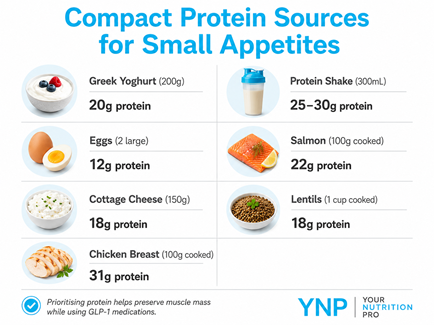
Best protein sources when your appetite is small
When you can only manage small volumes of food, choose protein sources that deliver maximum grams per serve:
- Greek yoghurt (170g serve) — ~17g protein
- Eggs (2 eggs) — ~12g protein
- Cottage cheese (200g) — ~24g protein
- Tinned tuna or salmon (95g tin) — ~22g protein
- Chicken breast (100g cooked) — ~31g protein
- Tofu, firm (150g) — ~14g protein
- Legumes/lentils (½ cup cooked) — ~9g protein (plus fibre)
Protein-first eating — what it means in practice
Because GLP-1 medications create rapid fullness, your meal order matters. Eat your protein source first, before vegetables and carbohydrates. This ensures you reach your protein target even if you become full quickly before finishing the meal. It is a simple habit change with significant long-term impact on muscle preservation.
Fibre — The Underrated Priority
GLP-1s slow digestion — fibre needs careful management
GLP-1 medications slow gastric emptying, which can worsen constipation if fibre intake increases without adequate fluid. The targets remain the same: approximately 25g per day for women and 30g per day for men — but the strategy is gradual increase with parallel increases in water intake (aim for 8–10 glasses daily).
Best fibre foods on a reduced appetite
Choose foods that deliver both fibre and nutrients in compact servings: oats, lentils, chickpeas, edamame, chia seeds, and mixed beans. These double as protein sources, making them especially efficient choices.
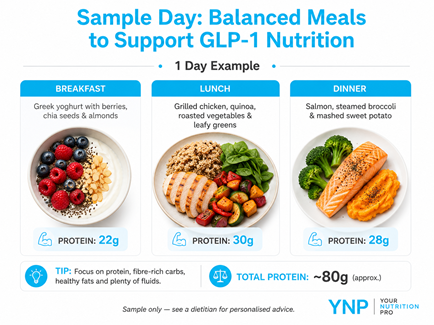
What Does a Day of Eating Look Like?
The following is a demonstration of principles, not a prescribed meal plan. Individual requirements vary significantly. Work with a dietitian for personalised guidance.
- Breakfast: Greek yoghurt (170g) with ½ cup berries and 1 tbsp chia seeds — approximately 20g protein, 8g fibre
- Lunch: 2 boiled eggs + ½ tin tuna on a small bed of leafy greens with olive oil — approximately 28g protein
- Dinner: 100g grilled salmon with ½ cup steamed edamame and roasted vegetables — approximately 35g protein, 7g fibre
- Optional snack: Cottage cheese (½ cup) with sliced cucumber — approximately 12g protein
- Total: ~95g protein across the day — within range for a 70kg person at 1.4g/kg target
Foods to Limit (Not Eliminate)
Certain foods are more likely to worsen the common side effects of GLP-1 medications — particularly nausea and bloating. These are not "bad foods" — they are simply harder to manage at this stage:
- Fried and high-fat foods — significantly worsen nausea and slow digestion further
- High-sugar foods and drinks — reduce nutrient density of your already-limited intake
- Alcohol — can have a heightened effect on an empty stomach; also displaces nutrients
- Carbonated drinks — can worsen bloating and early satiety
The Role of Resistance Training
Nutrition and exercise work together to protect lean muscle on GLP-1 medications. Research is clear that structured resistance training (weight lifting or body-weight exercises, 2–3 sessions per week) combined with adequate protein is the most effective strategy for preserving muscle during weight loss. For specific exercise programming, please consult an Accredited Exercise Physiologist or Personal Trainer.
Why Work with an Accredited Practising Dietitian?
Dietitians Australia has publicly called for dietitian referrals to be paired with every weight-loss medication prescription in Australia — and for good reason.
A dietitian working alongside your prescribing doctor can:
- Calculate your personalised protein and micronutrient targets
- Monitor nutritional status as your dose changes
- Adapt your plan when side effects like nausea peak (typically weeks 2–8)
- Assess whether a vitamin or mineral supplement is indicated
- Support the long-term maintenance phase after reaching your goal weight
Your prescribing doctor manages the medication. A dietitian helps you manage everything around it. Together, your outcomes are significantly better — and your muscle stays where it belongs.
Conclusion
GLP-1 medications are transforming metabolic health — the evidence for their cardiovascular, glycaemic and weight outcomes is extraordinary. But they are a tool, not a complete solution. What you eat on these medications determines whether you lose fat or muscle, whether you remain well-nourished or develop deficiencies, and whether your health truly improves beyond the number on the scales.
Protein first. Fibre steadily. Small volumes, maximum quality. And if you want guidance tailored to your body, your dose, and your goals — that's exactly what we are here for.
Want personalised nutrition support alongside your GLP-1 medication? Book a consultation with Chris Hughes, Accredited Practising Dietitian, at Your Nutrition Pro.
Frequently Asked Questions
Evidence-based answers from an Accredited Practising Dietitian
On Ozempic (semaglutide) or Wegovy, prioritise high-protein foods such as chicken, fish, eggs, Greek yoghurt, tofu, and legumes at every meal. Aim for 20–40g of protein per eating occasion and eat protein before other foods. Include high-fibre vegetables, oats and legumes for gut health, and stay well hydrated. Limit fried foods and high-sugar items, which can worsen nausea.
Yes, GLP-1 medications can contribute to muscle loss (sarcopenia) if nutrition and exercise are not optimised. Research suggests weight loss without targeted nutrition or exercise intervention may come from lean body mass. However, muscle loss is largely preventable with adequate protein intake (1.2–1.6g/kg body weight/day) and regular resistance training. Working with a dietitian is the most effective way to protect muscle while losing weight on GLP-1 medications.
Most experts recommend 1.2–1.6 grams of protein per kilogram of body weight per day while taking semaglutide (Ozempic or Wegovy). For a 70kg person, this is approximately 84–112g of protein per day, spread evenly across meals. This is higher than the general recommended intake to protect against the muscle loss that can occur with rapid weight reduction.
Dietitians Australia recommends that anyone prescribed weight loss medication in Australia also receives a referral to a dietitian. GLP-1 medications significantly suppress appetite, which can lead to nutrient deficiencies if food intake is not carefully managed. A dietitian provides personalised nutrition targets, monitors nutritional status, and supports long-term outcomes alongside your prescribing doctor.
In late 2025, the PBAC recommended Wegovy (semaglutide) for PBS listing for adults with established cardiovascular disease and obesity (BMI ≥35kg/m², or ≥32.5kg/m² for Asian and Indigenous Australians). The PBS listing is expected mid-2026. Speak to your GP to determine whether you meet the eligibility criteria. Tirzepatide (Mounjaro) and liraglutide (Saxenda) are not currently recommended for PBS listing for weight management.
On GLP-1 medications, limit fried and high-fat foods (which worsen nausea), high-sugar foods and drinks (which reduce diet quality without filling nutrient gaps), carbonated drinks (which worsen bloating), and alcohol (which can have a heightened effect and displaces essential nutrients). These are not permanent restrictions — but reducing them during active treatment makes the experience more comfortable and your nutrition more effective.
Check out our page packed with free recipe eBooks and resources to help you with a variety of conditions.
Stay connected with news and updates!
Join our mailing list to receive the latest news and updates from our team.
Don't worry, your information will not be shared.
We hate SPAM. We will never sell your information, for any reason.